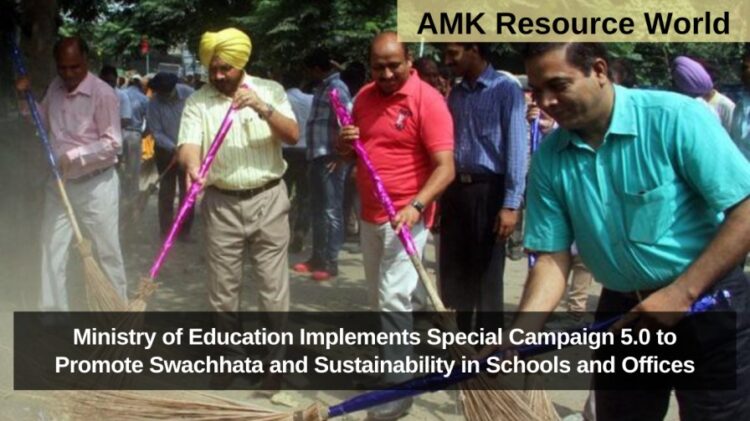
The Department of School Education and Literacy (DoSEL), under the Ministry of Education, has launched Special Campaign 5.0 from October 2 to 31, 2025, aimed at institutionalising Swachhata (cleanliness) and improving the overall efficiency and sustainability of government offices and schools across India. The campaign is part of a nationwide effort to promote clean, green, and digital work environments, aligning with the government’s vision of Swachh Bharat and Mission LiFE (Lifestyle for Environment).
Focus on Cleanliness, Efficiency, and Record Management
According to an official press release by the Ministry of Education, Special Campaign 5.0 focuses on reducing file pendency, improving administrative efficiency, and ensuring better record digitisation and management. Offices under DoSEL have undertaken extensive efforts in record weeding, digital filing, and clearing pending cases to streamline operations and enhance workplace productivity.
In schools, the campaign has translated into various maintenance and beautification initiatives, including whitewashing, painting, electrical repairs, and the upkeep of toilets and drinking water facilities. Campuses are being revitalised with murals and wall art inspired by traditional Indian art forms such as Madhubani, Warli, and Pattachitra, promoting cultural heritage alongside environmental responsibility.
Major Achievements Under the Campaign
The Ministry of Education reported remarkable progress as of October 15, 2025, with over 60,000 files reviewed across DoSEL offices. Out of 70,596 physical files identified for review, 60,659 have been examined, and 345 e-files closed after review.
Out of 233 references received from Members of Parliament (MPs), 140 have been disposed of. In addition, 1,111 public grievances were taken up, of which 607 have been resolved, along with 241 out of 510 public grievance appeals successfully addressed.

The Ministry also revealed that against the target of conducting 3,49,934 cleanliness and efficiency campaigns, a total of 61,243 activities have already been completed across government offices and educational institutions nationwide.
DoSEL and UNICEF Webinar on E-Waste Management
In alignment with Mission LiFE’s “Reducing E-waste” theme, DoSEL, in collaboration with UNICEF, organised a webinar on October 9, 2025, chaired by Secretary Sanjay Kumar. The session highlighted the importance of responsible E-waste management and the role of students and teachers in promoting sustainable digital habits.
Joint Secretary Amarpreet Duggal shared practical insights, urging participants to use digital devices for their full lifecycle, prefer cloud storage over physical drives, and adopt eco-friendly disposal methods. The webinar witnessed massive participation from over 1.5 lakh attendees, including educators, administrators, and students across India.
E-Waste Drives Across Five States
Following the webinar, E-waste awareness and management drives were launched on October 10 in Assam, Haryana, Punjab, Rajasthan, and Chandigarh under Eco Clubs for Mission LiFE. Over 1,000 schools are participating in activities aligned with the Ministry of Environment, Forest and Climate Change’s E-waste Management Guidelines, promoting practical learning and community involvement.
Schools have also been encouraged to engage alumni, Panchayati Raj Institutions, School Management Committees, and local communities through the Vidyanjali platform (vidyanjali.education.gov.in). This collaborative effort aims to foster a culture of shared responsibility and sustainability within the education ecosystem.
A Step Towards Cleaner and Greener Institutions
Through Special Campaign 5.0, the Ministry of Education has reaffirmed its commitment to fostering clean, efficient, and environmentally responsible institutions. By combining administrative reform, community participation, and sustainability awareness, the initiative is setting new benchmarks for eco-conscious governance and educational excellence.