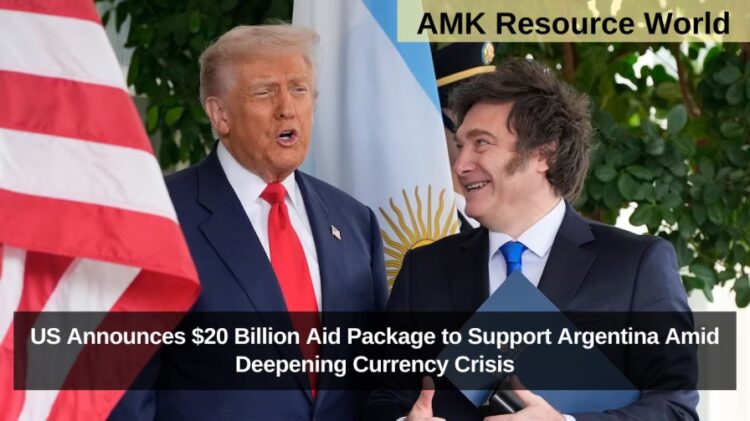
In a major geopolitical and economic development, the United States has announced a $20 billion financial aid package to assist Argentina in tackling its severe currency and economic crisis. The announcement came following a high-level meeting at the White House between US President Donald Trump and Argentine President Javier Milei, signaling Washington’s strong interest in stabilizing Argentina’s struggling economy.
However, the aid comes with a political condition. President Trump warned that continued US assistance would depend on Milei’s party winning the upcoming national elections scheduled for October 26, 2025. The move underscores Washington’s cautious yet strategic support for Milei’s pro-market economic policies and political leadership in Latin America.
US Extends $20 Billion Economic Lifeline to Argentina
The $20 billion aid package is designed to help stabilize Argentina’s foreign exchange reserves, curb inflation, and restore investor confidence amid growing fears of a financial collapse. Argentina’s peso has plummeted sharply in recent months, and the nation is facing one of its worst currency crises in decades.
According to official statements, the financial assistance will be channeled through a mix of dollar liquidity support, trade facilitation measures, and credit guarantees, aimed at shoring up the Argentine Central Bank’s reserves and ensuring the government can meet short-term import and debt obligations.
The White House described the aid as a “strategic partnership package” intended to reinforce Argentina’s economic stability and democratic governance. Trump also highlighted that Argentina’s economic revival was crucial to maintaining regional stability in South America.
Political Condition: Milei’s Election Outcome Holds the Key
While the announcement brings temporary relief to Buenos Aires, President Trump made it clear that the continuation of the financial support would be contingent upon President Javier Milei’s party retaining power in the upcoming October 26 elections.
Trump praised Milei’s austerity-driven economic reforms, stating that “President Milei’s reforms are difficult but necessary to bring Argentina back on the path of fiscal responsibility and growth.”
However, critics have warned that linking economic aid to electoral outcomes sets a controversial precedent, raising questions about US influence in Argentina’s domestic politics.
Argentina’s Economic Crisis Deepens
Argentina’s economy has been under immense strain since 2023, following sweeping austerity measures introduced by President Milei. His administration has implemented massive public-sector layoffs, subsidy cuts, and spending reductions aimed at curbing fiscal deficits and meeting International Monetary Fund (IMF) reform benchmarks.

Despite initial investor optimism, recent provincial election losses by Milei’s ruling coalition have shaken market confidence, leading to a steep peso devaluation and a surge in inflation. The consumer price index (CPI) has soared to record highs, pushing millions of Argentines into poverty and triggering widespread public protests.
Analysts fear that without immediate foreign assistance, Argentina could face another debt default similar to the crises of 2001 and 2018.
Global and Market Reactions
Global markets responded cautiously to the US aid announcement. The Argentine peso strengthened slightly, while sovereign bond yields saw modest improvement. Economists, however, warned that the relief could be short-lived if political uncertainty persists after the October elections.
The International Monetary Fund (IMF) welcomed the US initiative, stating that coordinated international efforts are essential to help Argentina restore macroeconomic stability.
The $20 billion US aid package to Argentina represents a crucial intervention at a time of deep financial distress. While the support offers short-term relief, its conditional nature tied to Javier Milei’s political survival adds a complex geopolitical layer to Argentina’s already fragile economic landscape.
As the October 26 elections approach, the future of Argentina’s economy — and its partnership with the US — will largely depend on whether Milei can secure another mandate to continue his austerity and market-driven reforms.