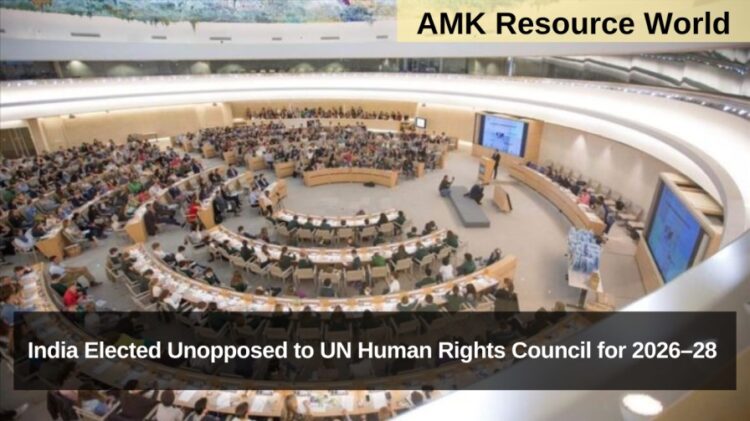
India has once again made its mark on the global stage, being elected unopposed to the United Nations Human Rights Council (UNHRC) for the 2026–28 term. This marks India’s seventh term on the 47-member body, underscoring the nation’s strong international reputation as a defender of human rights, democracy, and fundamental freedoms.
The election took place at the United Nations General Assembly (UNGA), where India received overwhelming support from member states. India’s victory reaffirms its growing influence and credibility as a country committed to promoting inclusive development, gender equality, social justice, and global peace.
India’s Seventh Term in the UN Human Rights Council
The UN Human Rights Council, based in Geneva, consists of 47 member countries, elected on a rotational basis by the 193-member UN General Assembly. India’s election to the Council for the 2026–2028 term highlights the country’s consistent engagement with the UN’s human rights mechanisms and its active role in addressing global humanitarian concerns.
Ambassador P. Harish, India’s Permanent Representative to the United Nations, expressed deep gratitude following the announcement, stating:
“India’s unopposed election reflects the international community’s faith in our commitment to the promotion and protection of human rights and fundamental freedoms. We are grateful for this trust and reaffirm our readiness to serve the Council’s noble objectives.”
India’s Commitment to Global Human Rights
India has been an active participant in global human rights dialogues, championing values such as equality, tolerance, and justice. As a pluralistic democracy with a robust constitutional framework, India has consistently emphasized that human rights and development go hand-in-hand.

Through initiatives like Digital India, Beti Bachao Beti Padhao, and Ayushman Bharat, India has sought to improve social inclusion, gender empowerment, and access to essential services — key components of the UN’s Sustainable Development Goals (SDGs).
Moreover, India has played a vital role in international humanitarian aid, peacekeeping operations, and refugee support, showcasing its leadership in promoting human dignity and equitable growth.
Global Recognition of India’s Role
India’s re-election to the UN Human Rights Council 2026–28 signifies widespread acknowledgment of its balanced and constructive approach to human rights issues. Unlike many nations that politicize human rights debates, India advocates for a cooperative and dialogue-based framework, emphasizing respect for national sovereignty and cultural diversity.
The country’s election also aligns with its broader diplomatic agenda, strengthening India’s position in multilateral organizations such as the United Nations Security Council (UNSC), World Health Organization (WHO), and G20.
What India Aims to Achieve During the 2026–28 Term
During its upcoming term, India aims to:
- Promote inclusive and sustainable human rights policies globally.
- Strengthen international cooperation to combat discrimination and inequality.
- Advocate for digital rights, climate justice, and women’s empowerment.
- Uphold freedom of expression, education, and access to health as fundamental rights.
India also plans to continue its focus on capacity building and technical cooperation with developing nations to help them implement their human rights obligations effectively.
India’s unopposed election to the UN Human Rights Council for the 2026–28 term is a moment of pride and global acknowledgment of its consistent advocacy for justice, equality, and freedom. As the world navigates complex challenges related to human rights and digital governance, India’s presence in the Council reinforces the vision of a human-centric, inclusive, and equitable global order.
With renewed commitment, India stands ready to contribute meaningfully to the UNHRC’s mission of protecting and promoting human rights for all.