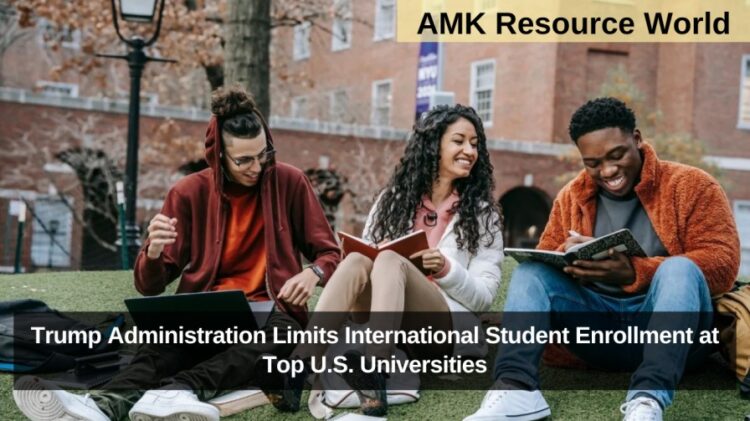
In a move that could significantly reshape American higher education, the Trump administration has issued a new directive limiting the number of international students allowed at some of the nation’s most prestigious universities. The policy, which forms part of a broader “Compact for Academic Excellence in Higher Education,” aims to reform admissions, funding, and institutional accountability — potentially altering the global appeal of U.S. universities.
Trump Administration Targets Leading U.S. Universities
According to a report by The Wall Street Journal, nine top universities have been specifically targeted under the new directive. The policy restricts international undergraduate enrolment to a maximum of 15%, while students from any single country cannot exceed 5% of the total undergraduate population.
The universities affected include:
- Massachusetts Institute of Technology (MIT)
- University of Pennsylvania
- University of Arizona
- Brown University
- Dartmouth College
- University of Southern California (USC)
- University of Texas
- University of Virginia (UVA)
- Vanderbilt University
White House officials stated that these institutions were chosen because their leadership showed openness to discussing and piloting the initiative. However, the administration has not released detailed reasoning behind the selection.

Broader Requirements for U.S. Universities Under the Compact
The new policy goes beyond student enrolment caps, introducing sweeping requirements that aim to enhance transparency, accountability, and merit-based admissions. The ten-point Compact mandates that universities:
- Make admissions and hiring decisions without considering race or gender.
- Release anonymised admissions data categorised by race, gender, and national origin.
- Require standardised testing (like the SAT) for all prospective students, including international applicants.
- Freeze tuition fees for five years and reduce administrative costs.
- Publish graduate earnings data for each degree programme.
- Provide tuition waivers for students in “hard science” disciplines if the university’s endowment exceeds $2 million per undergraduate student.
These measures are intended to increase transparency in higher education and address concerns about fairness and financial efficiency.
Compliance, Accountability, and Penalties
Universities agreeing to the compact must self-monitor compliance through independent auditors. These auditors will conduct anonymous surveys among faculty, students, and staff, with results shared with the Justice Department. Institutions that fail to adhere to the new standards may be required to repay federal funding and private donations.
Impact on U.S. Higher Education and International Students
The directive comes amid heightened tensions between the Trump administration and major universities over diversity, academic freedom, and antisemitism. While institutions like Columbia University and Brown University have agreed to financial settlements with the government, others — including Harvard — remain in dispute.
Already, DePaul University has reported a 30% drop in international student enrolment, leading to budget cuts and reduced spending. Experts warn that similar declines could follow nationwide, affecting the financial stability and cultural diversity of American campuses.
A Turning Point for Global Student Mobility
The policy marks one of the most significant federal interventions in U.S. higher education in recent decades. Critics argue that limiting international student numbers could reduce America’s global competitiveness, while supporters believe it will prioritise domestic students and promote academic integrity.
As the Trump administration’s education reforms unfold, the long-term implications for international student mobility, university funding, and global academic collaboration remain uncertain — but one thing is clear: the landscape of U.S. higher education is entering a period of profound transformation.