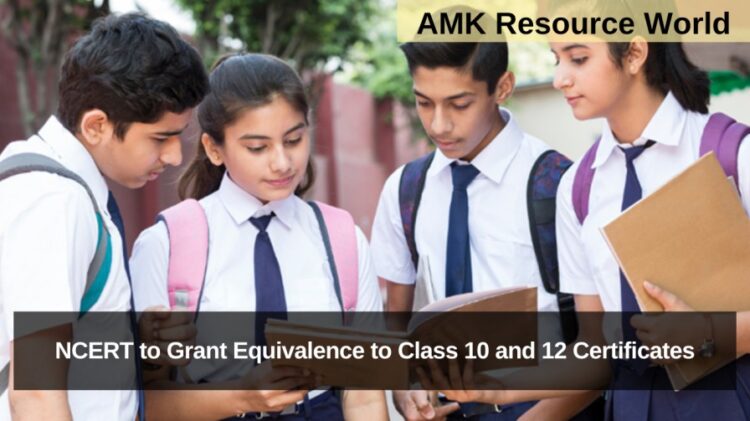
The Government of India has officially assigned the responsibility of granting equivalence to Class 10 and Class 12 certificates issued by various school boards to the National Council of Educational Research and Training (NCERT). This major policy change was announced through a notification published in the e-Gazette on September 6, 2025 by the Department of School Education and Literacy under the Ministry of Education.
The new order supersedes the earlier directive, which had entrusted this responsibility to the Association of Indian Universities (AIU). With this change, NCERT will now oversee the recognition of board certificates for both higher education admissions and employment opportunities, ensuring a streamlined and academically sound process.
NCERT to Handle Equivalence Through PARAKH
The notification clarifies that NCERT will perform this function through its national assessment centre, PARAKH (Performance Assessment, Review and Analysis of Knowledge for Holistic Development). PARAKH was established under the National Education Policy (NEP) 2020 with the goal of creating a standard-setting body for student assessments and examinations.
According to the Ministry of Education, “This institutional mechanism will ensure that equivalence determination is conducted through a robust and academically rigorous process that maintains the highest educational standards.”
This decision is expected to bring more transparency and reliability in the equivalence process, benefiting students from various boards, including state boards, central boards, and international boards operating in India.
Why the Shift from AIU to NCERT?

Earlier, the Association of Indian Universities (AIU) was responsible for granting equivalence of certificates. However, with the introduction of NEP 2020, there has been a push to align assessment standards with a uniform, credible, and research-backed mechanism. By assigning this task to NCERT, the government aims to integrate academic research, curriculum expertise, and holistic assessment under one national authority.
This move also highlights the Centre’s focus on ensuring that students from diverse education boards do not face challenges in securing college admissions or job opportunities due to differences in board evaluation systems.
Impact on Students and Institutions
The decision to assign NCERT with this responsibility will have a significant impact on:
- Students: Those who studied under different boards, including international ones like IB and Cambridge, can now seek equivalence through a unified NCERT-driven process. This will simplify applications for both higher education and government or private sector jobs.
- Universities and Colleges: Higher education institutions will have a standardized reference point when admitting students from different boards, reducing confusion and discrepancies.
- Employers: Organizations will be able to rely on NCERT’s equivalence certifications to verify the credibility of applicants’ qualifications.
A Step Towards NEP 2020 Implementation
This development aligns with the vision of NEP 2020, which emphasizes assessment reforms, standardization, and the use of technology and research to maintain quality in education. By using PARAKH, NCERT will bring in data-driven assessment tools, ensuring that Class 10 and Class 12 equivalence certificates are evaluated fairly and uniformly.
The Centre’s decision to transfer the responsibility of granting equivalence of Class 10 and 12 certificates from AIU to NCERT through PARAKH is a landmark move in Indian education governance. It not only enhances transparency, credibility, and academic rigor but also ensures that students from diverse educational backgrounds are treated fairly in admissions and employment processes.
This shift strengthens NCERT’s role as a key institution in the Indian education system and reflects the government’s commitment to building a standardized, equitable, and student-friendly education framework under NEP 2020.