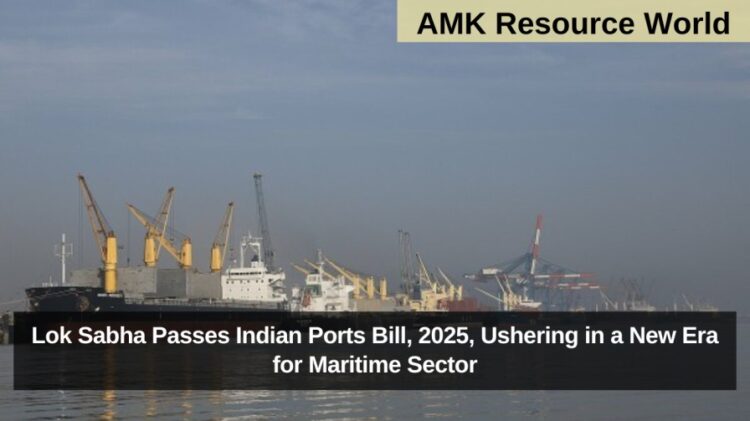
In a landmark development for India’s maritime industry, the Lok Sabha has passed the Indian Ports Bill, 2025, replacing the over-a-century-old Indian Ports Act of 1908. The bill introduces a modern, future-ready legal framework aimed at boosting efficiency, sustainability, and cooperative federalism across the country’s port ecosystem.
The 1908 legislation, a colonial-era relic, was widely considered outdated and inadequate for addressing the needs of a rapidly evolving maritime sector. With India aspiring to be a global shipping hub, the new bill seeks to align the governance of ports with 21st-century economic, technological, and environmental standards.
One of the central features of the bill is the establishment of the Maritime State Development Council (MSDC), envisioned as the apex body to foster cooperative federalism between the Centre and the maritime states. The MSDC will work to harmonize policies, resolve inter-state issues, and facilitate integrated port development. Complementing this national-level coordination, the bill also mandates the formation and strengthening of State Maritime Boards to improve governance, oversight, and operational efficiency at the state level.
The bill takes a forward-looking approach to digitization and automation of port operations. By enabling fully digitized workflows, real-time monitoring, and electronic documentation, it aims to minimize delays, enhance transparency, and reduce operational costs for stakeholders. The framework encourages the adoption of smart port technologies, including AI-driven logistics, blockchain-based cargo tracking, and automated gate systems.

In keeping with global sustainability commitments, the Indian Ports Bill, 2025 emphasizes green port initiatives. Ports will be encouraged to adopt renewable energy, shore power systems for vessels, waste-to-energy plants, and eco-friendly dredging methods. The focus on reducing carbon footprints aligns with India’s broader climate action goals and positions the country as a leader in environmentally responsible maritime practices.
The legislation also introduces a transparent tariff-setting mechanism, ensuring that port charges are fair, predictable, and based on standardized guidelines. This is expected to improve competitiveness, attract global shipping lines, and foster trust among domestic and international traders.
To accelerate infrastructure growth, the bill offers robust support for Public-Private Partnerships (PPP) and foreign direct investment (FDI). By creating a stable and investor-friendly environment, it aims to mobilize private capital and expertise for building world-class port facilities, enhancing cargo handling capacities, and improving hinterland connectivity.
Union Minister for Ports, Shipping, and Waterways emphasized that the Indian Ports Bill, 2025 is a pivotal step toward making India’s ports globally competitive. He noted that the combination of federal cooperation, technology integration, and sustainability will ensure that India’s maritime sector remains agile and resilient in a fast-changing global trade environment.
With the bill’s passage in the Lok Sabha, India is poised to transform its port infrastructure and governance, replacing outdated colonial frameworks with a progressive, future-ready maritime policy. The reform not only strengthens India’s position as a global maritime power but also promises significant economic, environmental, and logistical benefits for decades to come.