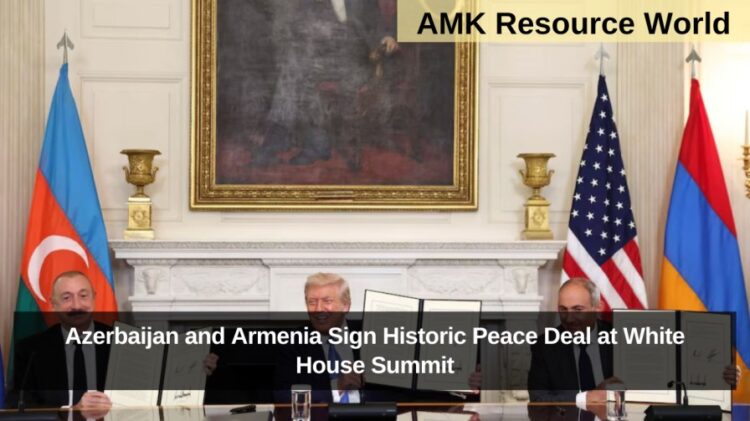
In a landmark diplomatic breakthrough, Azerbaijan and Armenia have officially agreed to end their decades-long conflict over the disputed Nagorno-Karabakh region. The peace accord, hailed as a turning point for the South Caucasus, was brokered at the White House, with U.S. President Donald Trump personally hosting the high-stakes summit.
The agreement brings an official close to one of the most enduring and violent disputes in the post-Soviet era, which has claimed tens of thousands of lives and displaced countless civilians since the late 1980s. Both nations have now committed to a framework that not only guarantees the cessation of hostilities but also lays the groundwork for a long-term partnership based on mutual respect, trade, and regional stability.
Under the terms of the accord, transport routes between the two countries will be reopened, a move that promises to reinvigorate trade and improve connectivity across the region. The reopening of these routes is seen as essential for fostering trust and enabling the free flow of goods, services, and people—elements that have been virtually non-existent due to decades of border closures and military tensions.
The deal also establishes formal diplomatic relations between Armenia and Azerbaijan for the first time since their independence from the Soviet Union. Embassies are set to open in each other’s capitals, and both governments have pledged to create frameworks for bilateral business cooperation, tourism exchanges, and cultural programs aimed at healing divisions between their peoples.

One of the most striking and symbolic elements of the agreement is the construction of the so-called “Trump Route for International Peace and Prosperity”—a major transport and trade corridor designed to connect mainland Azerbaijan directly to its Nakhchivan exclave, which borders Armenia, Turkey, and Iran. The corridor will include modern highways, a rail link, and supporting infrastructure, turning it into a vital artery for regional commerce and integration. According to initial plans, the route will be jointly financed by Azerbaijan, Armenia, and a coalition of international development partners, with the aim of making it a flagship model of cross-border cooperation.
Speaking at the signing ceremony in the White House’s East Room, President Trump hailed the agreement as “a triumph for peace, prosperity, and the power of diplomacy.” He credited the leadership of both Azerbaijani President Ilham Aliyev and Armenian Prime Minister Nikol Pashinyan for their willingness to compromise and envision a shared future.
“This deal will change the face of the South Caucasus,” Trump said. “Instead of barbed wire and blockades, we will have trade routes and friendships. Instead of war, we will have peace.”
International reaction to the accord has been overwhelmingly positive, with the United Nations, European Union, and Russia all welcoming the deal as a stabilizing development for a geopolitically sensitive region. If implemented successfully, analysts believe it could serve as a blueprint for resolving other entrenched conflicts worldwide.
For the people of Armenia and Azerbaijan, the hope is clear: that decades of bloodshed will give way to decades of peace.