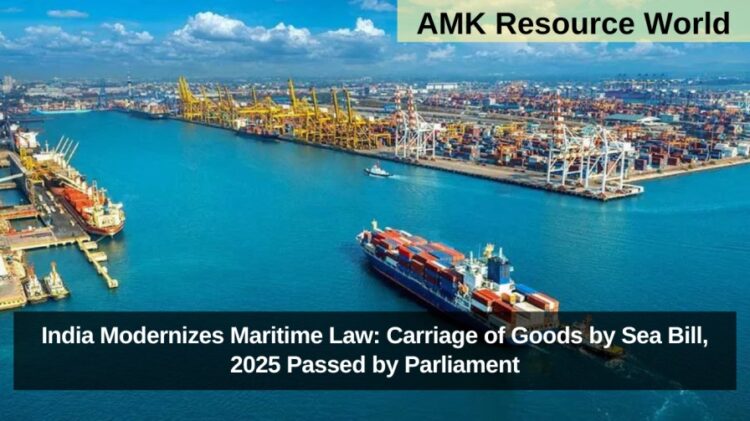
In a landmark development aimed at bolstering India’s maritime and shipping sectors, the Indian Parliament has passed the Carriage of Goods by Sea Bill, 2025, after it received approval from both the Rajya Sabha and Lok Sabha. This progressive legislation is set to replace the nearly century-old Carriage of Goods by Sea Act, 1925, bringing India’s maritime legal framework in line with contemporary international practices and technological advancements in global shipping.
The new Bill seeks to redefine the responsibilities, rights, liabilities, and immunities of various stakeholders involved in the carriage of goods by sea. This includes shipowners, shippers, and consignees, and addresses critical aspects such as risk allocation, loss or damage claims, and cargo documentation. One of the key highlights of the Bill is the modernization of the bill of lading system, a vital document that outlines the specifics of goods being transported. The Central Government has been empowered to amend the schedules and issue new rules to ensure flexibility and timely response to evolving global standards.
Minister of State for Ports, Shipping and Waterways, Shantanu Thakur, introduced the legislation with the objective of simplifying the shipping laws and enhancing the ease of doing business in the country. He emphasized that the bill would streamline maritime procedures, reduce legal ambiguities, and promote faster dispute resolution, which is essential for a competitive logistics ecosystem.

During the parliamentary discussion, BJP MP Sanjay Seth underscored the significant growth India’s maritime sector has achieved under Prime Minister Narendra Modi’s leadership. He revealed that cargo handling in Indian ports surged from over 819 million tonnes in 2014–15 to more than 1600 million tonnes by 2024, a testament to the sector’s rapid evolution and global integration. Seth noted that the passage of this bill will further accelerate the modernization of port operations and contribute to India’s ambition of becoming the world’s third-largest economy.
India’s maritime network is composed of 12 major ports and over 100 non-major ports, forming a strong backbone for both domestic and international trade. With an increasing volume of goods moving through Indian waters, the legal framework governing the carriage of goods needed a major overhaul. The Carriage of Goods by Sea Bill, 2025, thus arrives at a crucial juncture, reinforcing India’s commitment to global trade facilitation, maritime security, and economic competitiveness.
Industry experts have welcomed the bill, citing it as a vital step in creating a transparent, investor-friendly maritime environment. As India strengthens its position as a logistics and shipping hub in the Indo-Pacific region, this modernized legislation will play a pivotal role in enhancing trade efficiencies, reducing litigation, and ensuring confidence among global shipping partners.
The Carriage of Goods by Sea Bill, 2025, is not just a regulatory update—it is a strategic move to anchor India’s maritime aspirations to a robust and future-ready legal foundation.