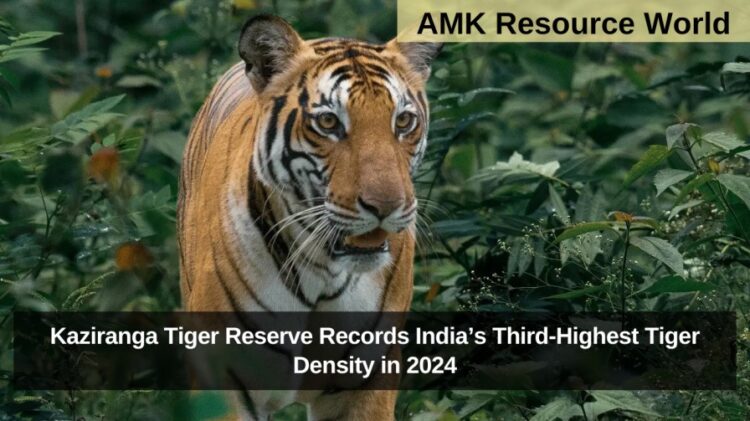
Kaziranga Tiger Reserve (KTR) in Assam has emerged as one of India’s leading tiger habitats, recording the third-highest tiger density in the country—18.65 tigers per 100 square kilometres—according to the 2024 report released on Global Tiger Day by Assam Chief Minister Himanta Biswa Sarma. This places KTR just behind Bandipur (19.83) and Corbett (19.56) in terms of tiger density.
The 2024 tiger count in Kaziranga stands at 148, a significant increase from 104 recorded in 2022. A key factor in this remarkable growth was the inclusion of the Biswanath Wildlife Division in the tiger monitoring process for the first time. The Biswanath division alone contributed 27 tigers to the total count, marking a major expansion of the core monitoring area.
Conducted between December 2023 and April 2024, the tiger census involved a 103-day-long camera trap survey, capturing over 4,000 tiger images. The data was analyzed using the spatially explicit capture-recapture (SECR) method, a scientifically robust technique that allows for accurate estimation of tiger numbers based on individual identification. The survey identified 83 female tigers, 55 males, and 10 whose gender could not be confirmed.

The population rise is also attributed to significant habitat expansion efforts. Approximately 200 sq. km of additional land, including 12.82 sq. km of encroachment-free terrain, was integrated into the reserve under the Burhachapori-Laokhowa sanctuary corridor. This expanded area has provided crucial connectivity for tiger movement, breeding, and dispersal—factors essential for long-term population viability.
“Kaziranga’s success is a testament to Assam’s commitment to wildlife conservation and scientific management of protected areas,” said CM Himanta Biswa Sarma while unveiling the report. He emphasized that efforts to secure corridors, prevent encroachment, and engage local communities have been instrumental in creating a safe haven for tigers and other wildlife.
Experts have lauded the increase in tiger numbers as a positive indicator of ecosystem health. Kaziranga, already globally renowned for its one-horned rhinoceroses, is now also being recognized as a critical stronghold for tigers in India’s Northeast.
The rise in Kaziranga’s tiger population and density highlights the effectiveness of integrated conservation strategies and sets a benchmark for other reserves across the country.