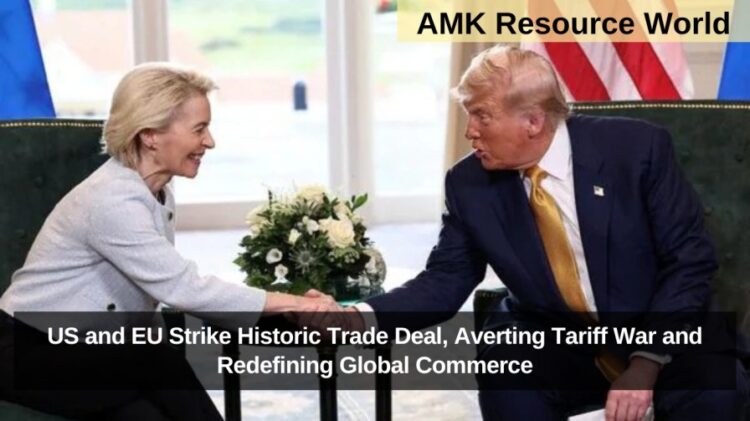
In a landmark agreement that reshapes global trade relations, the United States and the European Union have finalized a historic trade deal, reducing proposed American tariffs on EU goods and ushering in a new era of economic cooperation. The accord, announced jointly by Washington and Brussels, lowers the tariff on EU exports to the US to 15%, a significant drop from the previously threatened 30%, which had raised fears of a full-blown transatlantic trade war.
The deal also includes a sweeping economic package comprising $600 billion in EU investment in the United States, aimed at strengthening critical industries such as green technology, advanced manufacturing, and digital infrastructure. In return, the EU has committed to importing $750 billion worth of American energy, including liquefied natural gas (LNG), over the next decade—part of a broader effort to reduce Europe’s dependency on Russian energy sources.
While the Biden administration has celebrated the agreement as a major diplomatic and economic win, reinforcing US energy dominance and attracting vast foreign investment, European leaders have offered a more measured response. EU officials described the deal as stabilizing yet imbalanced, pointing to the still-high 15% tariff rate and concerns over long-term strategic autonomy in energy and industrial sectors.

Nevertheless, the agreement has averted a potentially damaging trade conflict, which could have disrupted supply chains, raised consumer prices, and further strained geopolitical relations. Instead, both sides have chosen a path of mutual compromise, paving the way for deeper integration of the world’s two largest economic blocs.
Analysts note that the deal could redefine global trade dynamics, signaling a shift toward more strategic trade partnerships based on security, energy independence, and technological leadership. It also sends a strong message to global markets that the US and EU remain committed to transatlantic cooperation, even amid rising protectionist sentiments and geopolitical uncertainty.
The agreement is expected to be ratified by both the US Congress and the European Parliament later this year. As global powers continue to recalibrate their economic alliances, the US-EU trade accord marks a critical moment—balancing economic pragmatism with political necessity in an increasingly fractured world order.