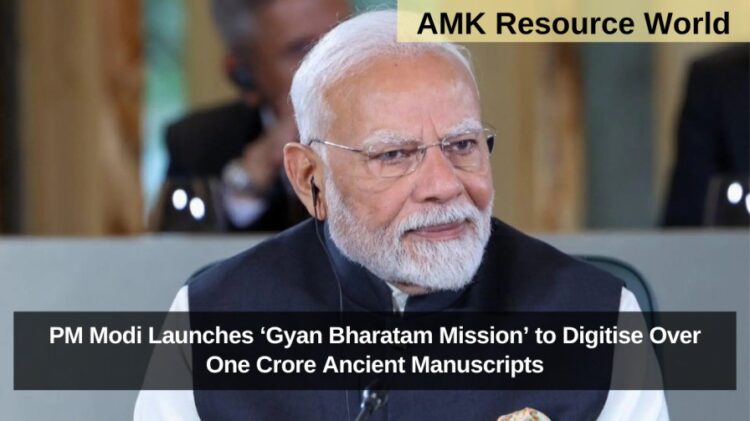
During the 124th episode of his monthly radio program ‘Mann ki Baat’, Prime Minister Narendra Modi unveiled the ‘Gyan Bharatam Mission’ (GBM)—a landmark initiative aimed at the digitisation, preservation, and promotion of India’s ancient manuscripts. The mission is set to become one of the largest knowledge conservation efforts in Indian history.
Under this visionary programme, the Government of India seeks to survey, document, and digitally conserve more than one crore (10 million) manuscripts housed across academic institutions, museums, libraries, temples, and private collections throughout the country. These manuscripts, which span centuries and represent a treasure trove of knowledge in fields like philosophy, medicine, astronomy, and literature, form a crucial part of India’s civilisational heritage.
The Gyan Bharatam Mission has been launched as a Central Sector Scheme (CSS) for the period 2024–2031, with a total budgetary outlay of ₹482.85 crore. The initiative reflects the government’s commitment to protecting India’s intellectual and cultural legacy while making it accessible to future generations through digital platforms.

In a significant move, the Union Government, in its 2025–26 budget, has dramatically increased the financial allocation for the manuscripts preservation initiative—from ₹3.5 crore in the previous fiscal year to ₹60 crore. This reflects the strategic importance being accorded to heritage conservation and digital access to historical knowledge.
Prime Minister Modi highlighted the cultural and educational value of the GBM, stating, “India’s ancient manuscripts are windows to our glorious past. Through this mission, we are not just preserving history, but reviving the spirit of knowledge that once made India a Vishwa Guru.”
The GBM will involve coordination between the Ministry of Culture, National Archives of India, Indira Gandhi National Centre for the Arts (IGNCA), and state-level manuscript repositories. A national digital portal will also be developed to provide public access to scanned manuscripts, supported by metadata and translations.
Scholars, researchers, and students are expected to benefit immensely from this initiative, as rare and fragile texts that were previously inaccessible will now be available for academic study. The Gyan Bharatam Mission not only seeks to preserve the past but to revive India’s intellectual traditions in the digital age.