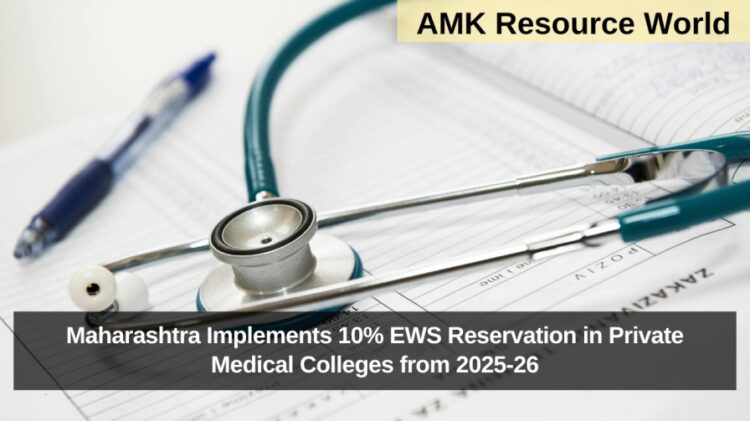
The Government of Maharashtra has introduced a 10 per cent reservation for Economically Weaker Sections (EWS) in private medical colleges, effective from the academic year 2025–26. The announcement was made through the Maharashtra Common Entrance Test (CET) Cell’s information brochure for undergraduate medical admissions, marking a significant shift in admission policy for private unaided institutions.
This reservation applies to students from the general category whose annual family income is below ₹8 lakh. The move aligns with Article 15(6)(b) of the Constitution of India, allowing states to reserve seats in private educational institutions for EWS candidates. It will be implemented across government, government-aided, municipal corporation, and private unaided medical colleges, excluding minority institutions.
The EWS quota was first introduced nationally in 2019 through the 103rd Constitutional Amendment, aiming to provide opportunities for economically disadvantaged individuals from forward castes. However, Maharashtra’s latest decision is the first time this reservation will be enforced in the state’s private medical colleges.

Until now, private colleges in Maharashtra did not have seat reservations for EWS students, though fee reimbursements were offered for eligible candidates. The new reservation directly reduces general category seats by 10%, leading to heightened competition for MBBS admissions. With 3,120 general category MBBS seats across 22 private medical colleges, around 300 seats will now be set aside for EWS candidates.
This sudden implementation has drawn criticism from students, parents, and college managements. Stakeholders argue that the reduction of general seats without expanding the total seat count may adversely affect both admission prospects and institutional finances. Unlike government medical colleges, private institutions have not received approval to increase their intake to offset the impact of the EWS quota.
Parents are concerned about rising cut-off scores and the potential increase in tuition fees. Colleges fear a loss of revenue, which may prompt them to seek new fee heads or revise existing fees. However, the Fee Regulatory Authority’s guidelines tie fee structures to audited financial records, complicating any immediate fee hikes.
Regulatory expansion requires clearance from the National Medical Commission (NMC), and no indication has been made that such approval is being pursued. Though courts in other states have advised increasing seat intake alongside EWS implementation, Maharashtra’s current plan offers no such provisions, prompting calls for policy review and stakeholder consultation.