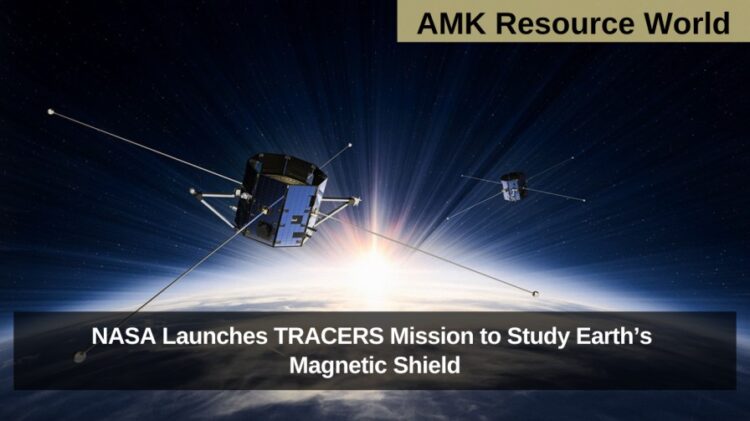
In a significant step towards understanding the dynamics of Earth’s protective magnetic environment, the National Aeronautics and Space Administration (NASA) launched the Tandem Reconnection and Cusp Electrodynamics Reconnaissance Satellites (TRACERS) mission in July 2025. The mission aims to deepen scientific insight into how Earth’s magnetosphere — the planet’s magnetic shield — deflects harmful solar wind emitted by the Sun.
The TRACERS spacecraft, a pair of identical twin satellites, was successfully launched aboard SpaceX’s Falcon 9 rocket from Space Launch Complex 4 East at Vandenberg Space Force Base in California, USA. This dual-satellite configuration will enable researchers to capture simultaneous multi-point measurements of the complex interactions taking place at the edges of Earth’s magnetic field.
UNDERSTANDING EARTH’S MAGNETIC SHIELD
Earth’s magnetosphere acts as a critical barrier that protects life by diverting charged particles from the solar wind. These solar emissions, when unimpeded, can potentially damage satellites, disrupt communications, and even affect power grids. At the same time, interactions between solar wind and the magnetosphere can trigger beautiful natural phenomena like auroras.

The TRACERS mission will focus on observing and analyzing one of the most scientifically intriguing regions of the magnetosphere: the cusp — an area near the polar regions where magnetic field lines funnel solar particles into the upper atmosphere. It is also the site where magnetic reconnection occurs, a process in which magnetic field lines snap and realign, releasing tremendous energy.
MISSION OBJECTIVES
TRACERS will:
- Investigate how energy and particles from the Sun enter Earth’s atmosphere through the cusp region
- Study the magnetic reconnection process in real-time
- Provide key data that will help scientists predict space weather phenomena that impact modern technology
The mission’s twin-satellite design allows for high-resolution spatial and temporal observations, offering an unprecedented look into fast-changing magnetic interactions. TRACERS will operate in low Earth orbit (LEO) and transmit data back to NASA for several years.
The launch of TRACERS represents NASA’s continued commitment to advancing space weather research and Earth science. As the Sun enters a more active phase of its 11-year cycle, the mission will provide critical data to help scientists understand the processes that safeguard Earth from solar threats — ensuring both technological resilience and human safety.