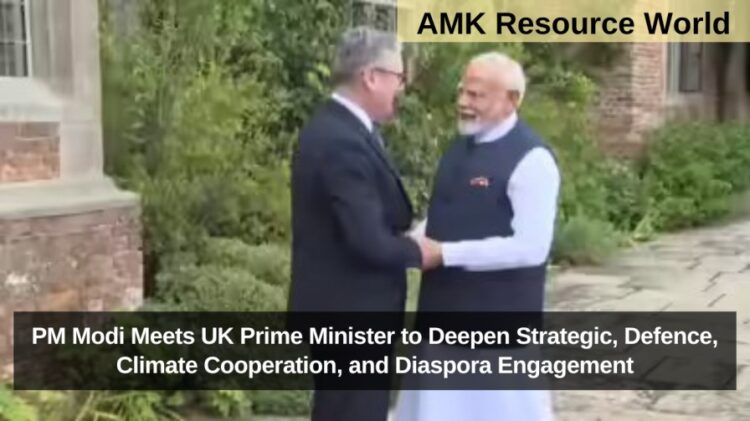
In a major diplomatic push, Indian Prime Minister Narendra Modi met with UK Prime Minister Keir Starmer in London on 24 July 2025 to elevate the nations’ Comprehensive Strategic Partnership. Their discussions focused on strengthening ties across defence, climate, innovation, and diaspora engagement—anchored by the signing of a landmark trade and strategic pact.
The two leaders convened at Chequers, the UK PM’s country residence, where they finalized the India–UK Comprehensive Economic and Trade Agreement (CETA), marking a historic moment in bilateral relations
CETA will eliminate tariffs on 99 percent of Indian exports and cut duties on 90 percent of UK goods—bringing down import tariffs on Scotch whisky from 150 percent to 75 percent immediately, then to 40 percent over a decade, and reducing Indian auto tariffs to 10 percent under quota With parliamentary approval pending, the pact is poised to double bilateral trade by 2030 and inject roughly £25 billion (~₹2.5 trillion) into both economies by 2040
Beyond economics, Modi and Starmer endorsed a new India–UK Vision 2035, establishing flagship cooperation in clean energy, AI, quantum technology, education, and finance—including linking India’s GIFT City with UK capital markets

They also launched a Double Contribution Convention, paving the way for professional mobility and aligned social-security contributions under the trade agreement
Defence and security received fresh impetus, building on ongoing 2+2 ministerial dialogues and joint military exercises. The leaders pledged deeper collaboration on maritime security, tech-enabled warfare, cyber defences, and defence-production under India’s flagship “Make in India” programme, Notable ongoing drills include Exercise Konkan, Ajeya Warrior, Cobra Warrior, and Tarang Shakti—showing operational reinforcement across the Arabian Sea and UK-based military ranges.
On climate, both sides reaffirmed commitments to industrial decarbonisation, green tech, and pandemic preparedness through the India–UK Science & Innovation Council. They endorsed the Net Zero Innovation Virtual Centre, and pledged increased climate finance and resilience-building shared agenda
A warm highlight was diaspora engagement: tens of thousands of British Indians welcomed Modi in London, and at the joint press conference, he graciously switched to English when his Hindi interpreter faltered—a moment praised by Starmer and the media as a token of cross-cultural respect.
In sum, this two‑day visit—Modi’s fourth to the UK—signifies a qualitative upgrade in the India–UK relationship, intertwining trade, defence, green cooperation, and cultural unity as both nations chart a strategic course toward 2035.